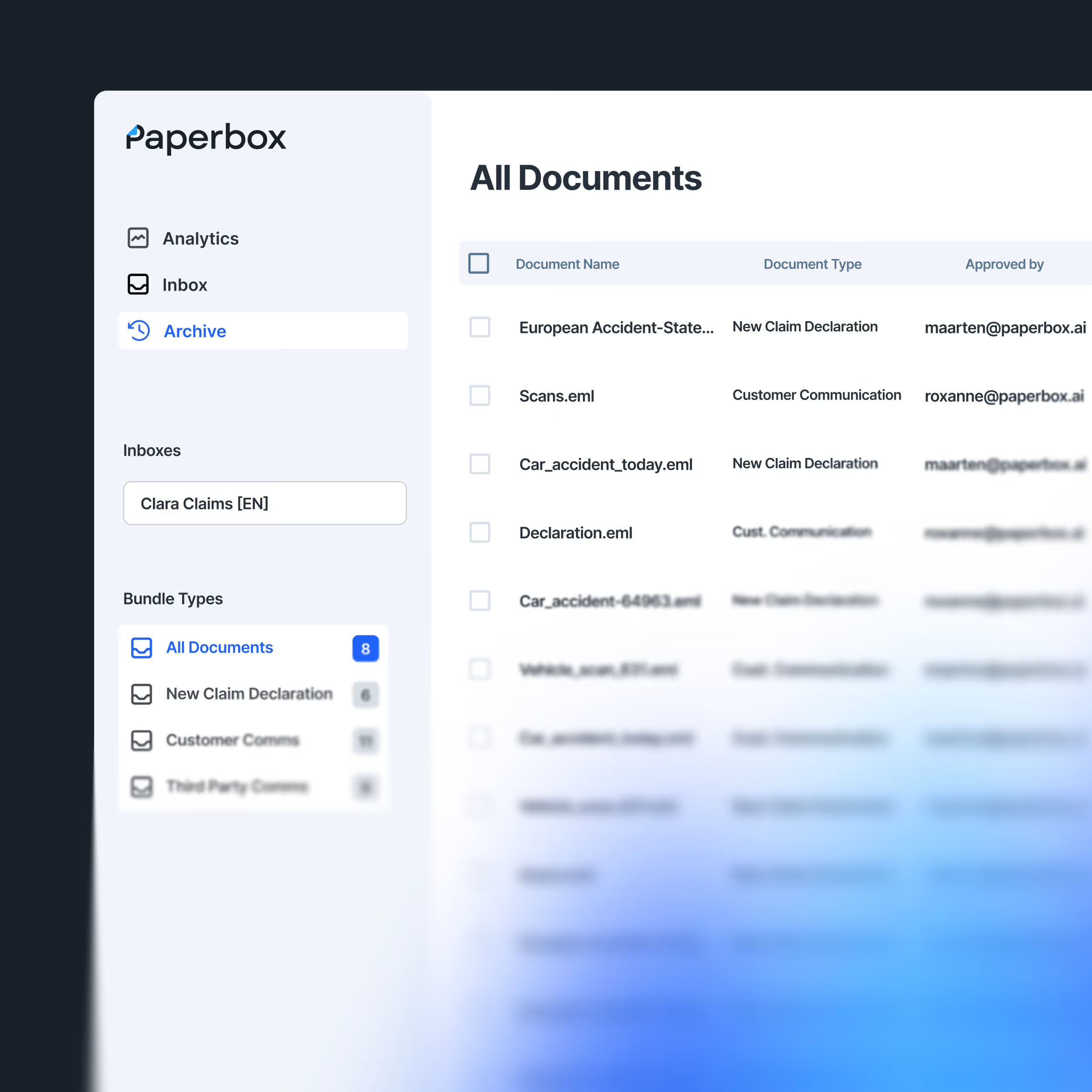
VKG is a service provider and delegated authority. VKG manages insurance portfolios on behalf of brokers and acts as the link between brokers and major insurers such as ASR and De Goudse. This means that VKG: Serves the broker as its customer — not the end insurer or policyholder. Is responsible for full portfolio management and the related correspondence. Must continuously adapt to the way each individual broker works. Processes large daily volumes of incoming claims correspondence through centralised mailboxes.
The pain points
Before implementing Paperbox, VKG faced a structural operational bottleneck in the processing of claims correspondence.
High manual workload
All incoming claims-related emails and documents arrived in centralised mailboxes. Employees had to manually:
- Assess and categorise each message through triage.
- Classify correspondence by type.
- Prioritise messages based on urgency or SLA agreements.
- Register and forward tasks in the Level system.
Error-prone and inconsistent processing
Manual triage at high volumes inevitably leads to errors: incorrect classifications, missed SLAs and inconsistent processing. Every deviation creates additional correction work and can potentially damage the relationship with the broker.
Strategic risk: AI disruption
In addition to daily operational pressure, VKG — like the wider insurance sector — faces a more fundamental challenge: the rise of AI threatens to disrupt traditional, labour-intensive service models. A purely manual process is not sustainable in the long term. To avoid being replaced by AI, organisations need to embrace it by embedding AI into their operational processes.
The solution: Paperbox as a triage layer
Paperbox was integrated as a deep, intelligent triage layer on top of VKG’s existing workflows — without the need to replace existing systems or processes.
Without Paperbox
• Manual reading of every email
• Manual classification by correspondence type
• Manual prioritisation based on SLA
• Manual registration in Level
• Capacity peaks difficult to manage
With Paperbox
• Automated triage of incoming claims emails
• Intelligent classification by document type
• Automatic SLA-driven task prioritisation
• Automated task registration in Level
• Scalable without additional headcount
What is in scope?
Paperbox automates the full triage process for claims-related correspondence:
- Triage of incoming emails and documents.
- Classification by correspondence type, such as claims confirmation, progress update or closure notice.
- Prioritisation based on SLA parameters.
- Registration of specific, SLA-driven tasks in VKG’s Level system.
- Filing and archiving of documents and correspondence in Level.
The results
The implementation of Paperbox for the claims use case delivered concrete and measurable results.
+60% Automation rate of all claims correspondence
0× System replacement integrated into existing workflows
24/7 Availability independent of staffing
Operational impact
- More than 60% of all incoming claims correspondence is processed fully automatically — without human intervention.
- Employees can focus exclusively on the remaining 40% of complex or exceptional cases.
- SLA compliance is safeguarded through automatic prioritisation, regardless of volume or time of day.
- The claims team’s scalability has been structurally improved without expanding headcount.
Strategic impact
- VKG has made its operational core future-proof against AI disruption.
- Paperbox enables VKG to use AI internally as a way to protect its business model, rather than seeing it as a threat.
- The solution is non-invasive: no process changes, no system migration, and direct integration into existing Level workflows.
Conclusion
The claims use case at VKG is a proven success story in intelligent process automation. Paperbox does not act as a standalone automation project, but as a strategic layer that enables VKG to protect and strengthen its existing, highly standardised processes.
With a 60% automation rate for claims correspondence, VKG has shown that AI adoption does not need to start with a large-scale transformation. It starts with a targeted, measurable intervention in operational pain points — and that is exactly what Paperbox delivers.
“Paperbox makes VKG future-proof, not by changing everything, but by making the existing way of working smarter.”
Link with the “Advisor of the Future” vision
The Advisor of the Future initiative starts from one clear ambition: the insurance advisor should be able to focus as much as possible on advice and customer relationships, rather than administrative processing.
As a service provider for insurance brokers and advisors, VKG plays a central role in this. VKG supports brokers in managing insurance portfolios and processing correspondence with insurers.
By automating claims correspondence with Paperbox:
- large volumes of emails and documents are automatically triaged and processed
- the administrative workload at VKG is reduced
- VKG can support its brokers more efficiently
AI does not replace the advisor. Instead, it removes repetitive administrative work, allowing advisors to focus on their core role: guiding and advising customers.
In this way, Paperbox helps VKG turn the Advisor of the Future vision into a practical reality.